
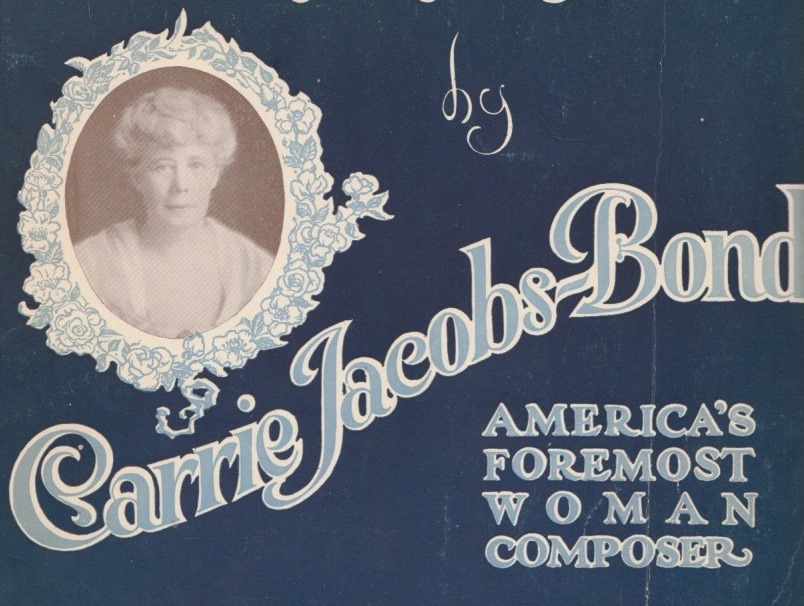
As wildly popular as Taylor Swift in her day, Wisconsin born Carrie Jacobs-Bond became viral the old fashioned way, through the sale of sheet music. Several of her songs became standards employed for years for special occasions. Music wasn’t a passion, but a way to survive adverse and turbulent times, and hopefully leave life better if only for a few moments. In the process, she “sung and ‘talked’ herself into the hearts of her own American brothers and sisters from the humblest home to the White House…” per the November 5, 1908 Salem Republican.
Born August 12, 1862 in Janesville, Wisconsin to a country doctor, young Carrie Jacobs grew up a shy and sickly child enamored of reading and music, with a great ear for playing songs after one hearing. Forced to drop out of college after her father’s death, she married Edward Smith, gave birth to their son Frederick John Smith in 1882, and divorced before falling in love with doctor Frank L. Bond, marrying him June 10, 1889. While happily married, Bond struggled with debilitating rheumatism, finding some comfort performing songs she had composed in local recitals. The couple worked to better the life of all, as Bond became President of the small town of Iron River beyond his calling as a doctor. On December 3, 1895, Bond passed away, with newspapers stating he died of inflammation of the bowels.
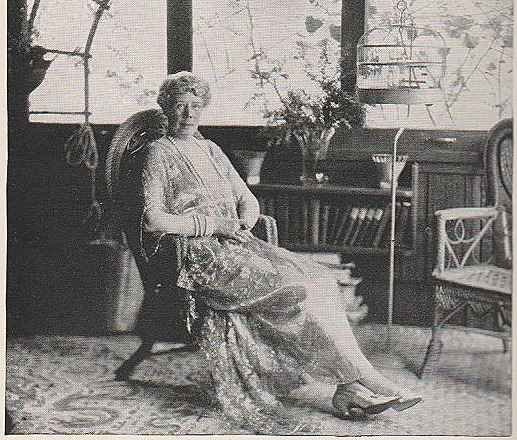
Left a widow at 33 with a young nine-year-old son to feed, Bond contemplated how to survive in an age without disability payments, life insurance, and many occupations for women, with what she considered no great talents to advance herself. She moved to Chicago with young Fred, painting china and embroidered waists of dresses to help pay her bills while they survived genteel poverty, eating one meal a day and selling off everything but the family piano. Her son eventually left school after finishing eighth grade to earn extra money. Determined and persevering, Bond sold verses to greeting card companies before realizing she could sell them on her own behalf, struggling for years to make it.
Bond eventually came to the realization that music would most successfully pay the bills, turning her focus to writing songs and performing. She began playing recitals in people’s homes, earning $15 a performance. The struggling woman turned to vaudeville as well, but earned hisses after her first professional appearance in 1900, stepping away from the field until 1920. She found many a blackhearted publisher wiling to print her verses or songs, but not pay for them. She did earn a little for four songs published in 1899.
Mrs. Jessie Bartlett Davis loaned her $200 to start her own publishing company called the Bond Shop at 5535 Drexel Avenue (actually a corner of her home) in 1904 to capitalize on her compositions and to make a living. Releasing her own self-produced sheet music, with covers she designed, conceived, and produced, Bond began receiving royalties, eventually selling over 275,000 copies of her first book called “Seven Songs as Unpretentious as the Wild Rose.” She became the first woman to establish her own music publishing company and the first to earn a $1 million in music sales after licensing recording rights to her work, eventually publishing more than 175 songs and finding many released on records.
Growing a name giving recitals, first in homes and then in ever larger theatres and auditoriums, even without a powerful or great voice, Bond’s charming and sweet songs began to sell, as Billboard later said she “performed the style of music that the people want.” What today might be called sentimental or emotional music appealed to the hearts of listeners in a gentler, more compassionate and caring time, when families spent time together, especially singing songs around the piano. Her joy in performing and caring for people gave her work power.
Bond’s compositions grew out of improvisations until a mood and expression came to her, and thus led to songs expressing such emotions and moods as love, friendship, faith, patriotism, awe, and solace. Bond explained her writing to a newspaper in 1918, stating, “A song is somewhat like radio. I just keep tuning in to find that vibrant response. There is very little difference among us when it comes to the language of the heart.”
President Theodore Roosevelt invited her to perform at the White House for his family and a few guests in November 1907, helping to further popularize her music across the country. This greater success forced the move of the Bond Company to larger and more posh headquarters at 246 Michigan Boulevard. Bond struck up a friendship with German opera singer Madame Schumann-Heink in 1906 after meeting while both were performing in Atlantic City. Spending time together, Bond dedicated a song to her, and the diva sang Bond compositions in concert. This also popularized her music, leading to more than 26 language translations of her songs and helped land recording contracts from early music companies. Her most popular works worldwide included “I Love You Truly” (1901), which became a wedding perennial for decades, and “A Perfect Day” (1910), often sung at regular family gatherings. The verses for the song “A Perfect Day” were conceived at the Mission Inn in Riverside as a way to thank friends, before she composed the music for it a few months later.
As early as 1900, Bond traveled to different states performing her compositions in recitals, earning room and board through performances or by staying with friends or patrons. Word of mouth and newspapers expanded her popularity and sales, the only “viral” way to promote anything in those days. She came to California in the early 1900s, traveling to cities performing music and selling her sheet music and poetry books. When visiting Hollywood in the winter, Bond played the piano at the Hollywood Hotel to pay her bills. Bond gave an interview to the Los Angeles Times in May 1907, telling them, “I have learned to laugh, for a smile is a lot better than a frown, and it goes far in the right direction.” Perhaps other papers reprinted the interview, as these lines are similar to lyrics in Charlie Chaplin’s song “Smile” as well as the Ira Gershwin song “Lose that Long Face” in the 1954 “A Star is Born,”
Falling in love with the climate and warm winters, Bond eventually moved to Hollywood permanently in 1916, constructing a homey, comfortably Craftsman bungalow at 2042 Pinehurst Road just north of Franklin Avenue and only about four blocks to the Hollywood Hotel. Thanks to its location at the tail end of Pinehurst, Bond would name her home “The End of the Road,” which was surrounded by gardens and the hills behind it. Just a few years later, she constructed another home a few steps down the street as an investment property, leasing it out to renters.
Always active in women’s organizations and community betterment, Bond joined local groups like the Hollywood Woman’s Club, Hollywood Community Chorus, Los Angeles Women’s Athletic Club, and Hollywood Opera Club, hosting teas and receptions, giving lectures, performing, and headlining fundraisers. She aimed to improve her community through music, composing songs for the Community Chorus and helping organize and promote the Hollywood Bowl. She also supported Christine Wetherwill Johnson’s efforts to create a theatre for the Pilgrimage Play at what is now called the John Anson Ford Theatre, highlighting Christ’s life and sacrifice. Bond worked to better and build up society, bringing compassion, hope, and opportunity, especially to women. Bond wrote songs for World War One relief, and heard back from U. S. Sammies how much her songs, especially “A Perfect Day,” meant to them stationed far away from home.
Recognizing his mother intended to stay put, Smith decided to relocate the Bond Shop from Chicago to Los Angeles in 1920, purchasing land at 1770 N. Highland Avenue and constructing an office building to contain their headquarters and space to rent out. Once locating to Hollywood, Smith and Bond decided to form Carrie Jacobs-Bond Film Corporation, which would employ her songs as themes for films, which could be promoted using the same.
While the company never actually produced films, it inspired the industry to recognize the power of Bond’s words and how they could create emotional moments in movies. Bond would be invited to industry events and screenings, building bonds between them. “A Perfect Day” would be perfectly employed in the wonderful 1939 Christmas film “Remember the Night” starring Fred MacMurray and Barbara Stanwyck. Taking a pretty shoplifter home for the holiday because she has nowhere else to go, John Sargent and his loving, sympathetic family sing “A Perfect Day” around the piano, moving Stanwyck’s Lee Leander to tears. Bond’s song “I Love You Truly” is sung as Jimmy Stewart and Donna Reed’s characters George and Mary marry during another touching holiday film, “It’s a Wonderful Life,” released in 1946.
As she grew older, Bond traveled and performed less, though she continued composing and writing. She completed her autobiography, “The Roads of Melody” in 1927, writing, “The only thing that seems at all remarkable about my life is that I was nearly thirty two before I even thought of having a career. It was the necessity of supporting myself and my little son that made me a writer of songs.”
Even at the age of 78, she wrote and performed the song “The Flying Flag” at a San Francisco fundraising concert in 1940. Bond died peacefully at her home December 28, 1946, leaving two granddaughters after the suicide of her son. Newspapers around the world published her obituary, and ASCAP, the American Society of Composers and Publishers, praised her work. In 1970, the Songwriters’ Hall of Fame inducted her into their honor rolls.
Bond’s determination and will to succeed represents that of all women’s yearnings at the time to employ their talents and skills for something more than just a hobby, to achieve success in their own right. She also demonstrated how more mature persons could still successfully contribute in business and creative endeavors, while at the same time mentoring and teaching younger people on how to build and advance their skills. Influential and incredibly popular in society in the early decades of the 1900s, Bond was that era’s Taylor Swift, uniting people of all generations while promoting upbeat and positive attitudes. Her background and personality helped pave the way for young women like Swift and Beyonce, showing the power and continuing influence of women to change the world.

 ladailymirror.com
Once again you’ve alerted me to someone I’ve never heard of, though I recognize some of the the music.
Thanks Mary.
Sylvia
LikeLike