
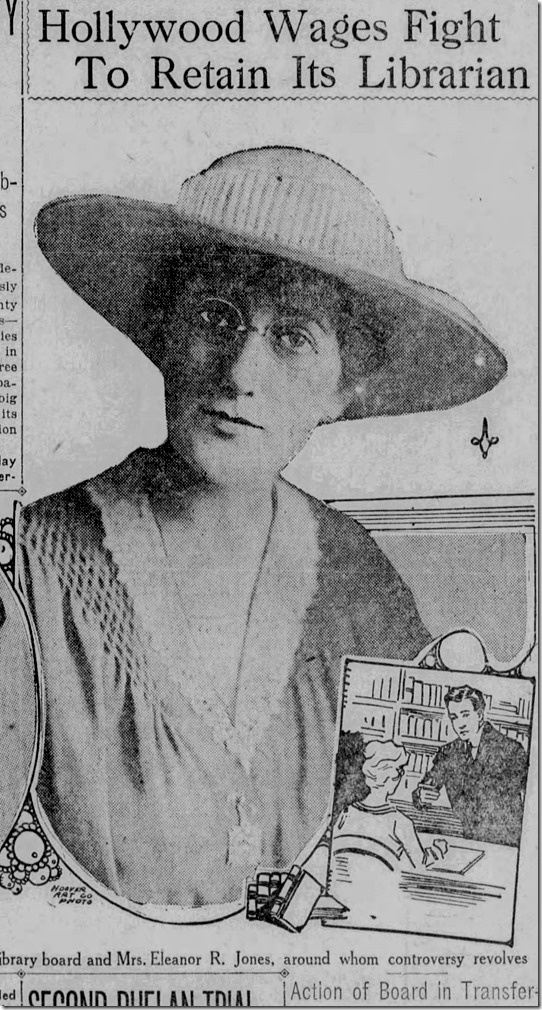
 Coming to Hollywood in 1907, Eleanor Brodie Jones determined to make a difference in the small community. For over 22 years, she brought a love of reading, knowledge, and growth to everyone through her successful work in community engagement and outreach, offering programs for all ages and ensuring access to cultural and artistic events through various clubs and societies, but especially as Hollywood librarian. Jones’ evolution of the library and its impact on society parallelled Hollywood’s rise as an artistic community thanks to her work. She also left an indelible mark by inspiring the construction of the Hollywood Studio Club, a safe and encouraging residence for young women immigrating to the city in hopes of making it in movies. Her leadership provided a much needed home for single women stepping out on their own to succeed in the business world.
Jones was born in New York and arrived in Hollywood after teaching English literature at Lincoln High School in Nebraska before arriving in Hollywood as a widow with a young son. She led the Hollywood library for 18 years, starting when it was a single room and later expanded into a large, graceful building at Hollywood Boulevard and Ivar Avenue, one of the most used branches in the city of Los Angeles. The stalwart woman would not only serve the community, but raise a handicapped son on her own as a widow at a time when few women worked outside the home.
Jones graduated from Training School offered by the Los Angeles’ library, preparing her to head the Hollywood library branch, built through the push of local women, who organized the Hollywood Woman’s Club in 1905 specifically to open a library. After Andrew Carnegie gave most of the funds and Daieda Wilcox Beveridge provided land at what is now Hollywood Boulevard and Ivar Avenue, the library opened in 1907, led by the Library Board. Jones was named head librarian in 1908, and kept in position after Hollywood was annexed to Los Angeles in 1910.
She aimed to serve everyone as Hollywood librarian, telling the Hollywood Board of Trade in 1914 that it was the “most democratic institution in the community,” one builiding up the city with quality books and programs and free to operate. Jones stated that it had been successful “because it has been striving to keep pace with the progress of the Hollywood high school and Hollywood Board of Trade.” As moving picture studios began arriving and setting up shop in Hollywood, she offered for the library to conduct research on their behalf, looking to make the library integral to industry as well. Later she arranged for the library to provide books for the enjoyment of Hotel Hollywood guests in the lobby, or by interlibrary loan from the downtown branch.
Her aim was to provide thoughtful, engaging literature that opened minds and challenged preconceptions. Writer L. Frank Baum praised Jones’ work when describing why he loved the Hollywood library in 1917. He believed her management and skill enriched the library. “…I must congratulate our Hollywood librarian on her success in developing so great a public interest in our home library that the community now considers it a most enjoyable and valued asset.”
As librarian, Jones endorsed all forms of cultural enrichment, a way to expand the mind as well as social opportunities. She organized art exhibits in the library with art by local artists. As a member of the Friday Morning Club, she gave lectures on recent books and other cultural touchstones. She belonged to the Hollywood Woman’s Club as well, giving as well as attending educational lectures. Jones served as the chair of the Literary Committee, arranging speakers for learning sessions and helped organize the Hollywood Art Association to broaden Hollywood’s artistic programs. She even wrote book reviews for the Citizen News on current issues to ensure an informed citizenry, such as in 1918, when she described the Armenian genocide as described in Herbert Adams Gibbons’ memoir, “The Blackest Page of Modern History.”
Jones worked her magic introducing children to arts and culture, opening their world to new opportunities, experiences, and viewpoints. As President of the Los Angeles chapter of Dramatic League of America in 1916, and chair of its children’s theatre program, she joined with organizers of the Children’s Theatre program at the Pasadena Library to organize a pint size presentation of Indian poet Tagore’s poem, “Postoffice” as well as other productions.
Jones saw her work as promoting arts and culture in general, not just as Hollywood’s librarian. In 1916, she endorsed Lillian Burkhart Goldsmith’s drive to build an outdoor Greek theatre to host pageants and concerts with visiting artists serving as guest stars, all at a price that average citziens could afford. With the support of a large swath of Los Angeles’ clubs, organizations, and population, County Supervisors overwhelmingly approved it, leading to the construction of what is now Griffith Park’s Greek Theatre. She also served on the founding committee for the Hollywood Bowl, organized by women. The University of California even appointed Jones to a committee examining University Extension classes.
The community adored Jones and all she brought to her job. When the library system decided to transfer her to Vermont Square in 1917, they wrote letters to the editor, promoted a petition protesting the proposal, and ended up winning, keeping her as Hollywood’s librarian. Showing her appreciation, she rallied the community in passing a bond increasing funding for all libraries in November 1918.
As she wrote in a Hollywood Citizen News editorial shortly before, “The Public Library is a great opportunity. A college without entrace fee or examination; a Club without dues; A Society of the best minds where no introduction is needed. The most democratic institution possible. It serves all purposes of civic life, industrical, social, religious and recreational. It is available twelve hours out of the twenty-four every working day. It assists the education of the young and completes that of the adult. It enables those lacking knowledge to become the equals of those more fortunate. It is truly American presenting to the citizen and the immigrant our history and the ideals of our government. It is cosmopolitan because it houses the works of nationalities, either in the original or in translation, and is thus an admirable substitute for foreign travel and intercourse….The best citizens are those who use it most freely, and widen their horizon by looking into the past and the future.”
With its share of the money in 1919, the Hollywood Library acquired more books, gave books out through the schools, and organized more programs for boys and girls that summer. She and her assistants gave school classes tours of the library, instructing them how to use card catalogs and reference sections.
Thanks to her work around Los Angeles, the California Federation of Women’s Clubs named her their chairperson of their Department of Literature in 1919. She would ensure speakers and work to keep members informed through lectures and other learning opportunities. Jones’ dream was to educate and inform all people she encountered.
She succeeded in increasing library usage beyond her dreams. By 1921, community engagement had exploded so much that a new library was required. Jones advocated and promoted bonds to construct a new, larger library at Hollywood and Ivar, along with saving the current library and moving it westward in order to serve even more customers. The city approved the bond measure, leading to the issuance of $500,000 in bonds to construct a new central library as well as the Hollywood branch. While construction ensued on the new building, the library moved to the seventh floor of the Security and Trust Savings Bank at Hollywood and Cahuenga to continue operations until the June 1923 opening of the brand new facility, for which she commissioned architect Rudolf Schindler to create an art gallery space.
After 18 years as head of the Hollywood Library and an almost year-long illness, Jones retired in 1926, to be appointed hostess of the downtown central library branch. In her new position, she would organize lectures and art exhibits, but unfortunately retired months later due to her health issues. The intrepid woman continued her yeoman work informing and educating Los Angeles citizens, helping to create curious, thoughtful persons. Many recognized her work as Hollywood librarian, with the Hollywood Citizen News writing in 1928 that she “made the library a warmly hospitable headquarters for Hollywood people and for strangers. Her sympathy and understanding attracted writers, scholars, playwrights, research workers, and art and dramatic students, all of whom found in her quick intelligence and genuine interest an unfailing store of inspiration and help.”
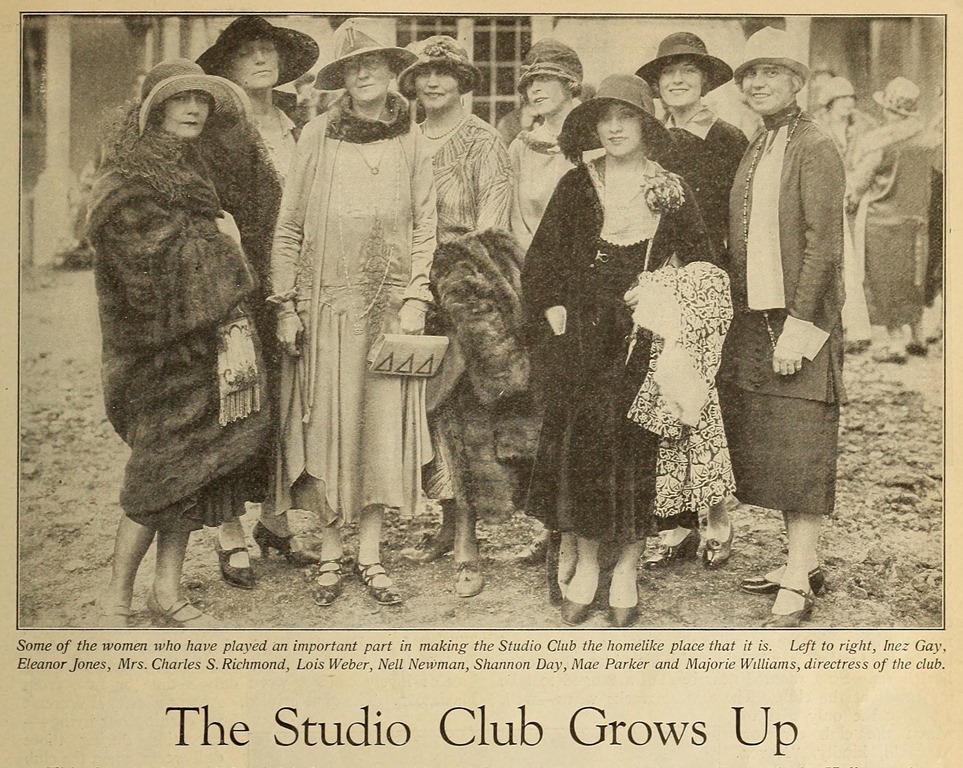
In 1927, many recognized perhaps Jones’ greatest work at the opening of the Hollywood Studio Club, after a decade of exploding population of young women drawn to Hollywood by the romance of the movies. In 1916, Jones first noticed young girls remaining until closing time of the library because there was no other place to go. Sensing a need, she worked to fill it, protecting their dignity and providing education and opportunity.
Jones first offered classes and talks at the library for the young women, before the community provided a recreational hall on Hollywood Boulevard. Growth required renting and then purchasing a residence on Carlos Avenue and Yucca Street, with such actresses as Zasu Pitts, Marjorie Daw, and Carmel Myers among the first residents. Filled to capacity within three years, fundraising led to the purchase of 1215 Lodi Place from the Seward Cole estate, wih architect Julia Morgan designing a luxurious Mediterranean dorm building filled with loggias, reception rooms, lounges, auditorium with stage, dining room, and private rooms, financed and furnished by dignitaries throughout the entertainment industry. Without Jones first acknowledgment of the desperate need of the young women descending on Hollywood, it would not have been solved.
The Hollywood community was devastated at Jones’ death in September 1929, remembering her fondly for all she brought to the city, working to make it a city of the first class. Jones succeeded in bringing arts, knowledge, and culture to Hollywood, challenging preconceptions and opening minds to new ideas and values. Most importantly, she influenced the construction of the Hollywood Studio Club, providing a home for ambitious young women looking to make a mark in Hollywood. Eleanor Jones is truly a woman of importance in the development of Hollywood.

 ladailymirror.com