

Agnes Grew with a map showing the results from a survey of women movie-goers, 1945.
A leader in almost everything she tried, Agnes Grew is mostly forgotten like many other women working in the motion picture industry during the 1920s-1930s. Longing for both power and an opportunity to help others, she would lead departments as well as serve others both in her job and in private opportunities. Her aim was to inspire and aid women, demonstating their leadership capabilities.
Born February 14, 1891 in Brooklyn, New York as Agnes Mengel, she was raised in a middle class family, with her father Calvin a broker. While she claimed on one census form to have attended college, New York census records show her working as a secretary at 19. Grew soon became a bookkeeper for a clothing factory.
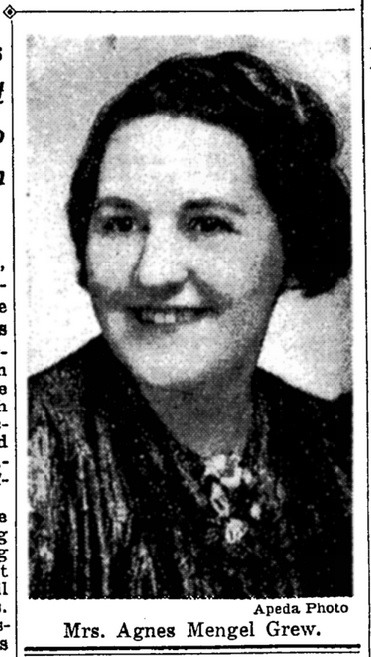 Just two years later, Grew ended up as an assistant in the purchasing department for Paramount Pictures in New York City, working in an over 40,000 square feet department on 25th St. in New York City, purchasing everything the company required for operation. In 1924, she was elected a director of the East Coast Paramount Pep Club, one of two women serving on the seven member board. She founded the Cooperative Buying Committee, securing discounts from businesses for employees. By 1940, she headed the Paramount Pep Club.
Sometime between 1922 and 1924 Agnes Mengel married and became Agnes Grew, but I cannot find marriage records for her. Like many women today, she worked under her full name, Agnes Mengel Grew. She gave birth to a daughter Patricia, and by 1928, Mr. Grew disappeared. Over the next few decades, she would list herself variously as widowed and then divorced on census records, listing herself as Grew on census forms but employing Mengel for job publicity..
Grew was a working mother, but obviously doing well from her job at Paramount. She and her daughter toured Europe on vacation and for the company in the late 1920s and early 1930s, even flying on a plane between Paris and Stockholm in 1928. They moved to White Plains in Westchester County in the mid-1930s, with Grew commuting into New York for her job. Over the next several years, she balanced motherhood with work and providing service to the industry, juggling many duties and responsibilities and succeeding on all fronts.
In 1938, Grew represented Paramount on the committee promoting the National “Go-to-the-Movies Week,”actually chairing the entire group. They were charged with organizing a “cooperative business-getting drive” to lure audiences to movie theatres. Those in the industry obviously recognized her acumen and skill in selling and purchasing quality goods for reduced prices. She would go on to lead the National Committee for Motion Pictures’ Greatest Year in 1939, helping raise funds and land advertisers for the project. By this time, Grew also headed Paramount’s own Purchasing Department, and aided her daughter in landing a radio show reading poetry every Saturday morning at 8:30 am for WMCA.
The Ottawa Journal interviewed her for a 1940 feature, which noted her experience in a specialized field as a young woman, buying special fabric and chemicals for a clothing manufacturing concern, which led to her purchasing duties at Paramount. The newspaper noted, “Special knowledge can open doors to women – and to men… .” The paper claimed she bought about $10 million worth of printing for Paramount over the 20 years of her employment with the company. Most years she would purchase around $500,000 in printing materials.
Growing restless at Paramount, Grew founded Agnes Mengel Grew Associates in 1939 to conduct nation-wide surveys on women’s taste in motion pictures in her free time. She independently financed the organization, and obtained the names of 2,500 women across the country who had answered a Motion Picture Greatest Year survey to poll first. Grew later added a more diverse 2,500 to give their opinions on the motion picture industry as well, telling the Buffalo Courier Express, “These women have definite notions about what they want. They’re a true cross section of the public, let’s see how they feel about pictures.” Two to three times a year, she mailed them a survey asking questions about what stars they liked, what type of pictures attracted them, what books they wanted adapted into films, and how often they attended pictures. Grew was therefore one of the first to recognize the need to understand women’s interest in films and then survey them about it. She led the way for entertainment market research that continues today. The executive claimed that 65% of movie audiences were women.
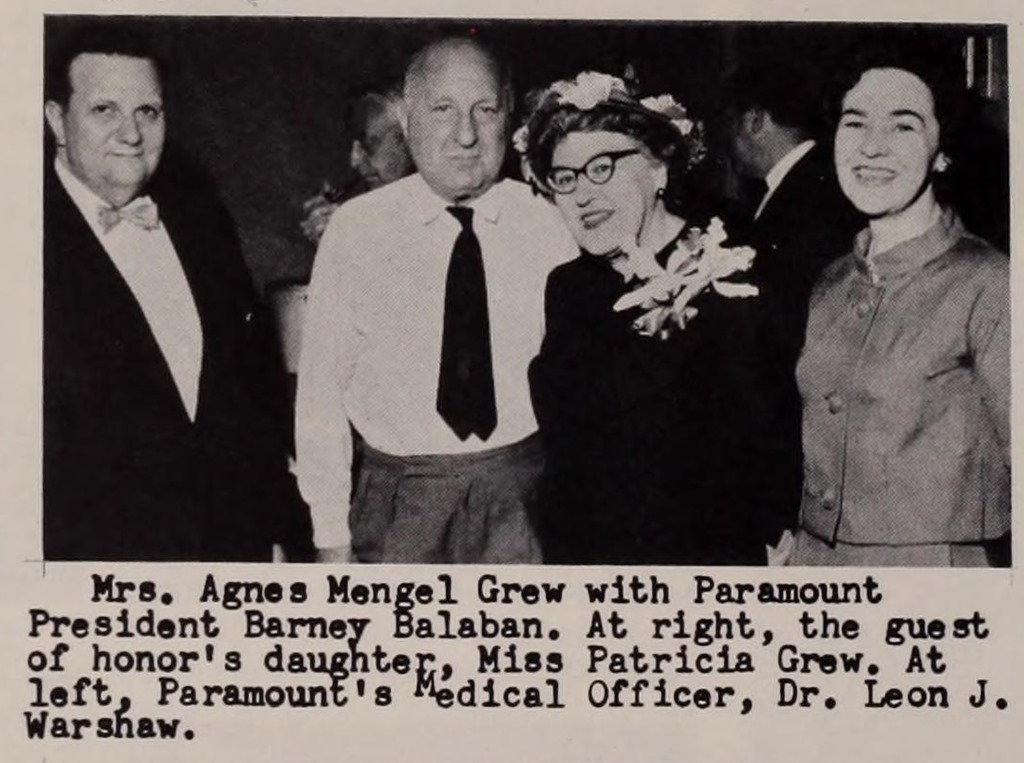
Grew’s surveys would determine what types of films attracted women to theatres and why. Her company’s survey in 1940 revealed that over 59% preferrred an average length film, while almost 39% favored long films like “Gone With the Wind.” Females voted heavily against duels in films, whie preferring travelogues, newsreels and cartoons as short subjects preceding features. Grew would speak to industry groups regarding women and their viewpoint, stating at a convention that women “would like to see some changes in entertainment.” Surveys in 1941 examined women’s like of various genres as well as broadcast mediums. Most preferred more viscera film to that of static radio, and more enjoyed entertaining films than those of “social significance.” Grew added a radio department in 1942.
Grew supported the War Effort in 1942, serving on the Fifth War Bond committee for the entertainment industry on behalf of Paramount, providing the same duties for the next two years. She displayed leadership, organization, and planning on these and other committees, demonstrating strength and confidence in research, making decisions, and helping others.
In 1946, Grew was elected the first female President of the Paramount Pep Club, which she had joined in 1921. After her election, she led the effort to change its name to the Paramount Pictures Club, Inc., a more distinguished and business sounding name. She found time as well to head Paramount’s Catholic group and the Choral Society, even organizing fundraisers at which the group would sing.
Grew would retire as the head of graphic arts purchasing June 23, 1962 after 41 years working for Paramount. She stayed busy even in retirement after moving to Connecticut, joining SCORE, Service Corps of Retired Executives sponsored by the U. S. Small Business Association. Once again she served as forerunner, starting the group in her county, the first woman in Connecticut to join the organization, and the first anywhere in the United States to lead a chapter.
A tralblazer in demonstrating women’s aptitude and talents for managing projects, taking initative, fundraising, and leading departments, Grew helped create market research and estabished leadership opportunities for women both in curricular and extracurricular activities. A forgotten presence, Grew provides an illuminating example of the many women who initiated practices and procedures in the motion picture industry to find themselves diminished or written out of history.

 ladailymirror.com