
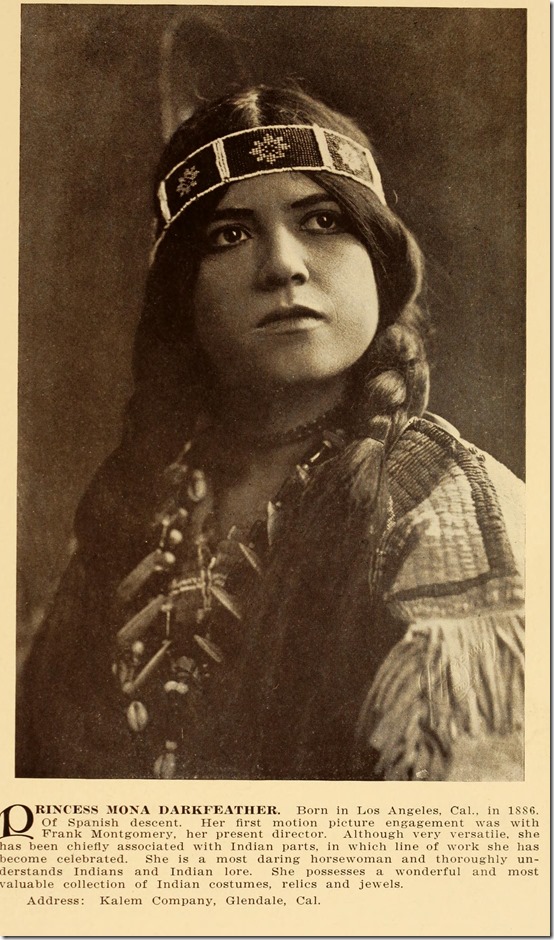
Long before Iron Eyes Cody was outed as non-Native American, silent film actress Josephine Workman claimed full Native American heritage, though only her maternal grandmother was actually Native American. Accentuating her dark, exotic looks and embroidered background, she took the screen name Princess Mona Darkfeather to gain fame as an Indian maiden in moving pictures in the mid-1910s, following after actual Native American Lillian St. Cyr, who had christened herself Princess Red Wing a few years earlier.
Perhaps realizing the success of Red Wing in moving pictures, Workman had decided to follow suit. St. Cyr had been performing on stage since the mid 1900s under the name Princess Red Wing, and was the first to appear on film in 1908, soon starring in shorts eponymously named and produced and directed by her husband James Young Deer, born James Young Johnson. In these shorts, Red Wing set the standard for decades worth of portrayals by Native American women – though stars, their characters often sacrificed themselves for white people who had befriended them, virtually never getting a happy ending or being the herioine of their own story.
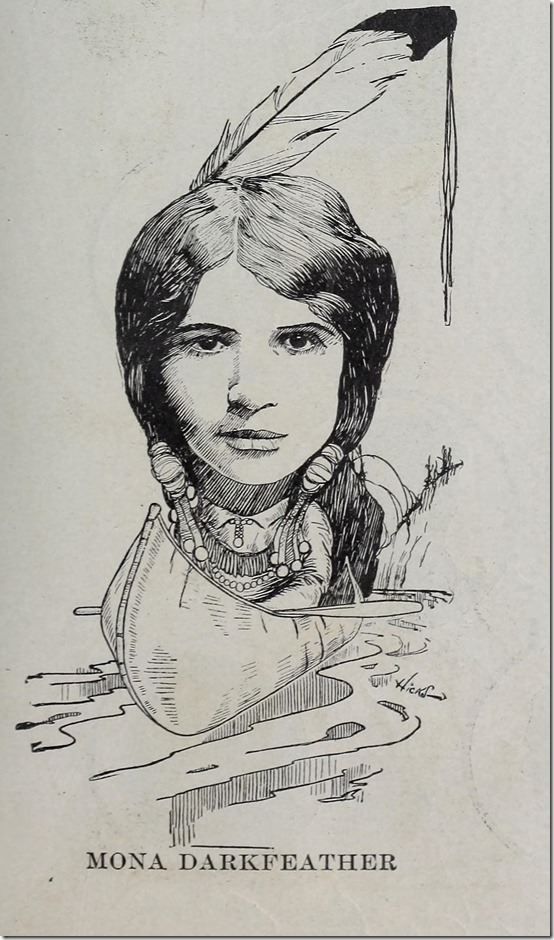
Born January 13, 1883 in Boyle Heights, east of downtown Los Angeles, actress Darkfeather was born Josephine Marie Workman, granddaugther to Los Angeles’ pioneer William Workman and his wife Nicolasa, from the Taos Pueblo tribe. Workman had immgrated from England in 1822, ending up in Missouri before moving on to New Mexico and later Los Angeles in 1841, where he eventually became a banker.
The United States Census and Los Angeles newspapers report Workman performing as a whistler as early as 1900. During this period, she was married for a short time. As she told Motion Picture magazine in ealy 1914, “I am not an Indian. My parents are Spanish, descendants of an aristocratic family. I was born in Los Angeles and educated there. I was supposed to be destined for the operatic stage and went thru a long course of voice cultivation; but the Moving Pictures attracted me, and I joined the original Bison company at Santa Monica, under my present director… .” To explain how she ended up playing Native Americans, she told another magazine, “I saw an advertisement in the paper calling for a Spanish type who could make up as a good Indian, and as I had to work, and stenography and myself do not mix well,….I summoned all my courage and applied for the position.”
Others as well as IMDB claim she starred in a 1909 short called “A Cheyenne’s Love for a Sioux,” but no entertainment trade credits any of the actors for the film. Entertainment trades in 1912 report her first working for Selig Polyscope Moving Picture Company that year. In fact, a March 1912 ad for the Selig film “A Crucial Test” credits Darkfeather, “the full-blooded Indian leading woman,” as star. An April 8 Selig release even employed her stage name in the title, “Darkfeather’s Strategy.”
Workman joined the Universal Bison Company by summer 1912, working out of the Glendale studio run by Frank Montgomery, portraying Indian women onscreen. The company produced many films featuring Native Americans, copying the work of Young Deer and Thomas Ince. Workman quickly gained renown at Bison. Many reviews praised her work portraying native women in a serious manner, as a “talented native” herself. Many stories also make note of her athletic skills, vaulting into the saddle from a running start. Her athleticism and acting attracted producer/director Montgomery, who featured her in many films. In fact, the couple would marry in 1912.
Several newspapers in 1912, however, “outed” Workman as non Native American. The Marysville Daily Appeal on December 12, while praising her work portraying Indians, wrote, “Princess Mona Darkfeather, who plays the leads in the Bison film company….is not a real Indian, as so many suppose, having been born in Los Angeles of an old aristocratic Spanish family.”
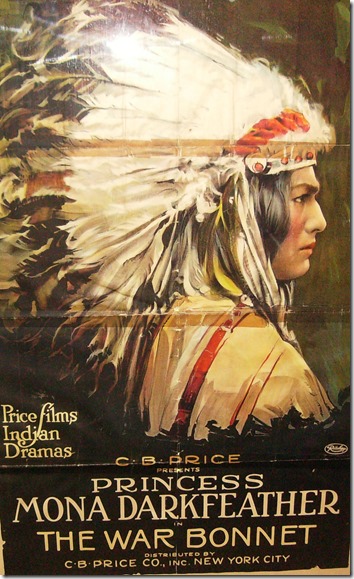 Early in 1913, Montgomery and Workman joined Kalem with fellow Bison actor Charles Bartlett to continue making western themed films. In May 1913, Montgomery and Workman got the “independent craze” as several papers called those wanting to establish their own companies. Motography stated that Montgomery established a brand called Mona Films, all to feature Workman as Darkfeather. These would be “special multiple reel features of Indian life,” but somehow they never seemed to gel. Just a month later, before even completing one film, the couple rejoined Universal. By the end of the year, however, they returned to Kalem.
Starting in 1913, Workman highlighted Native American art and lore, though her stories often changed. She told reporters Native American life had always interested her. She visited with tribes living in Santa Monica and began learning some of their languages and customs. She would claim to Motion Picture magazine that she was created a “Princess by Chief Rising Sun of the Arapahoe tribe after a two years’ sojourn with them,” though a year later she claimed to have lived with Blackfoot Indians and had been named a Princess by Chief Big Thunder of their tribe. She did collect Native American dress, jewelry, and curios.
While on one hand praising their art and work, she embroidered stories of companionship and friendship with many tribes. As Movie Pictiorial wrote about Workman, “She is an Indian princess and she is not, she is an exceptionally fine actress and she is not, really a most contradicting and interesting individual…Spanish and not Sioux.” Workman herself told the New York Tribune in May that the more she knew of Native Americans, the more she liked them. “I certainly consider it a compliment to be mistaken for an Indian.”
By fall 1914, Montgomery was ready for independence again. The couple left Kalem to produce films released by Sawyer, Inc. Workman would star in two-reelers each under the name “Darkfeather Features” or “Series,” and James Davis would produce one reel of comedy each week branded as the “Monty” comedies. As usual, Workman was typecast in her Native American persona, which they sold vociferously in print.
When Montgomery’s independent company failed to take hold, the couple returned to Kalem, still making western two-reelers. They spent the rest of the year ping ponging between various studios, Centaur and Universal, among them. Workman finally broke out of Native American roles at Centaur, occasionally playing contemporary young women. The couple was unfortunately becoming type cast for producing two reel western shorts, as more ambitious filmmakers increasingly turned to features. Their careers began slowing down. By 1918, Workman began appearing on stage talking about her film career and working with Indians before landing parts playing Native Americans in one-reelers for C. B. Price in 1919, all sold on states’ rights to only a few areas. While ads trumpeted that fifteen films would be produced, only a few actually saw the light of day.
With her career winding down, Workman, under the name Josephine M. Akeley, sued Charles G. Bassett of El Paso, Texas for almost $130,000 in 1920 to “reclaim” over 300 acres of walnuts near El Monte, California that had been sold after her father’s death to Bassett’s father, O. T. Bassett. Bassett believed he had sent quit claim deeds to all six Workman children, but the former actress claimed never to have received one. In 1869, her grandfather purchased 16,000 acres of the Rancho La Puente after it was divided in two, later gifting 800 acres to his son Joseph in 1872. At Joseph’s death in 1901, Bassett purchased the land. Over the next four years, the case made headlines as it made its way through the California courts, with Workman eventually losing.
By this time, Workman was reduced to strictly making appearances onstage, describing her filmic past and “rich” Native American history, performing in a rattlesnake dress. She would divorce Montgomery in 1928 and marry Alfred G. Wessling, divorcing him in 1935, and remarrying former husband Montgomery in 1937. They lived in her home at 1420 1/2 Mohawk St. in the Edendale area of Los Angeles, now called Echo Park, while he continued working as a sound engineer at the Hal Roach Studios.
Mostly forgotten by the motion picture industry and fans, Workman died of a stroke in a nursing home September 3, 1977 and was buried in Holy Cross Cemetery. While she obviously admired Native Americans, Workman took it to extremes in claiming full blooded authenticity. One of the first to build a career on false claims of indigenous heritage, Workman possessed remarkable history enough as heir to one of Los Angeles’ earliest pioneers to establish celebrity and respect.

 ladailymirror.com
James Young Deer was similarly not a true Indian.
LikeLike
Well actually, he was. He was descended from a tribe called the Moors of Delaware, who intermarried African Americans. Angela Aleiss has written about it in her book on Native Americans in film. He didn’t know at the time that there was Native American blood in his family, he just thought they were mulatto. He became Native American to get respect, not knowing that he already was.
LikeLike
Thank you for such an interesting article. I am a filmmaker and was researching a documentary I was working on and discovered Mona last year. She had nothing to do with the subject, I was looking for information on Fort Dearborn that was in Chicago, and she starred in a silent film about the battle that took place there. I was able to connect with Doug Neilson on the excellent Findagrave.com, Mona is his Great Grand Aunt, and he was able to have a marker placed for her grave at the cemetery. She had been buried in an unmarked grave.
LikeLike