
Just a few years after Susan B. Anthony and others organized the first Women’s Rights Convention in Seneca Falls, NY in 1848, women began working as photographers in the United States. While many took over their father’s or husband’s photography studio upon their loved ones’ deaths as a means of survival, many turned to the field as a form of artistic expression. Several focused on taking women’s portraits, as ladies often felt more comfortable sitting for other women. Women photographers began moving westward, looking for opportunity and new areas in which to serve. Others fell in love with the field, striving to learn and grow as practitioners.
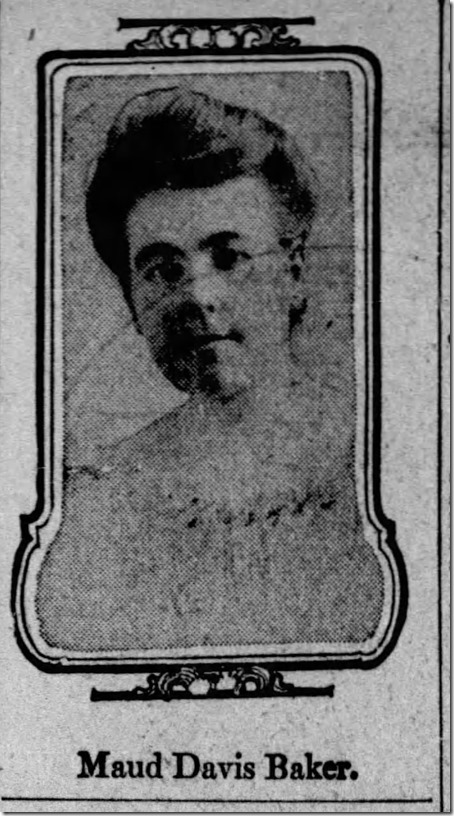
Maud Davis would become one of these early practitioners. Little is known of her early life. Born in Cleveland, Ohio in 1861 and the daughter of Judge Davis of Deer Lodge, Montana, she met older Englishman Thomas C. Baker who had come West somewhere along the way, and married. They ended up in Helena, Montana in the late 1880s with their two children Thomas and daughter Viroque, where he served as secretary of the Buskett Mercantile Comany in Granite before dying of spinal meningitis. Mrs. Baker took an active interest in the arts, attending women’s meetings, hosting them, and taking a strong interest in politics. In 1894, the Democratic County Convention in Lewis and Clarke County nominated her for superintendent of schools. After losing in November, she was elected enrolling clerk of the Montana State Legislature, serving for a short time before discovering a new love, photography.
 In September 1895, Baker departed Montana for Chicago and New York to study the artistic new medium. For the next year she apprenticed with renowned photographer Steffer. She returned to Montana in August 1896, and resumed work for a short time as enrolling clerk before opening her own photography studio on Grand Street in Helena, across the street from the Helena Hotel in 1897. Opening on the second floor of the Power Block in November, Baker focused on artistic portraits as one of a handful of women photographers in the state, gaining a good reputation for quality. The Jefferson Valley Zephyr praised her work on December , stating, “…it is always a delight, to even the most conservative, to meet a woman who has discarded the old traditions and found for herself an avocation for which she is eminently fitted…Her work is unexcelled by any photographer in the state and includes the new carbon and platinum processes. Love of her calling is manifest in all she does….”
For the next six years, Baker worked diligently in her studio, turning out lovely portraits and entering and winning recognition in exhibitions for the Helena Camera Club. She began touring to other cities around the state making portraits, earning more money and gaining more recogition. In 1902, Baker was appointed photographer to accompany Captain Henry Chiltenden’s United States engineer corps and record their work in Yellowstone that summer.
Perhaps looking for more challenge and opportunity, Baker decided to move West to Los Angeles in summer 1903 with her children after auctioning off the household furniture in July. Soon after arriving, she opened a studio at 913 Hill Street and began shooting portraits of society women, perhaps the first woman portraitist in Los Angeles. The Los Angeles Herald praised her work in September 1905, stating she was one of the best known women photographers over the last ten years, The paper called her work of “charming originality and artistic value that set her pictures apart from the oridinary run of photographic work seen everywhere. It is needless to say that Mrs. Baker’s pictures are high class.” Besides taking portraits, Baker turned to producing pictorialist works, whose soft focus and romantic look were quickly becoming popular across the country.
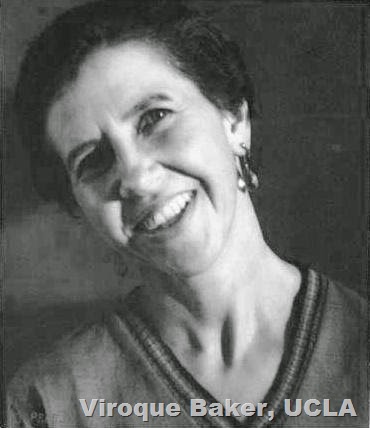
Her dedicated work inspired her teenage daughter Viroque, who also took up photography after observing her mother’s way with a camera and clients. Born Augusr 28, 1889 in Montana, Viroque was known as a tomboy, focusing on horseback riding and hiking. After the family moved to Hollywood in 1912, young Viroque began studying the craft to assist her mother at the 1616 Vine Street home and studio. Enamored of the art, she traveled to New York in 1916 to study at the Clarence White School of Pictorial Photography and then at its summer school in New Canaan, Connecticut. Viroque thrived, particularly in the areas of landscape and architecture.
Upon returning to Hollywood in October, young Baker opened her own photographic studio at 6511 1/2 Hollywood Blvd. in the Kaiser Apartments. Besides working in the field, Viroque hosted an exhibit of her work, particularly that taken back east for the Clarence White School, where one image had been chosen the best of 100 in a pictorial exhibit. As her mother Maud slowed down and turned to other artistic pursuits, Viroque Baker stepped forward as the main photographer in the family. Some reviews praised her work for their “pictoralist-like effects.” Traveling with her mother, she found inspiration in places like Mexico and Europe, drawn to dramatic landscapes.
Baker dedicated herself to photographing landscapes, advertising work, and commercial businesses, realizing they offered more steady and higher paying work. She became renowned in her own right, enjoying a notable collaboration with young architect R .M. Schindler and other artists and archiects. Schindler would design her new studio in 1925 and she often photographed his new works. Besides working as a photographer, she also sold early American chinaware and glassware in her studios as she moved around Hollywood in the 1920s.
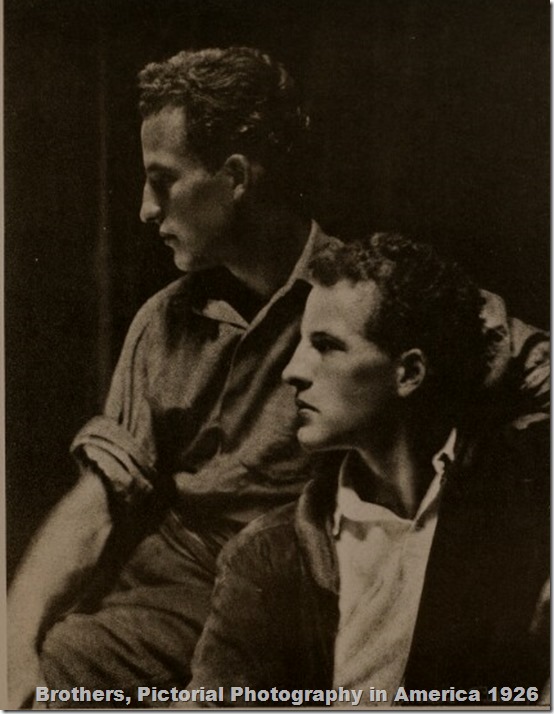
Brothers, photographed by Viroque Baker, Pictorial Photography in America, 1926.
As Baker enjoyed a growing reputation, commissions grew. She would shoot for such magazines and journals as Touring Topics, Town and Country, Country Life, Garden and Home, and Art and Architecture, of homes, art exhibits, businesses such as Bullock’s Wilshire and I. Magnin, and even Hoover Dam. Superstar Mary Pickford even hired her to make photos of the Fairbanks Pickford Studio on Santa Monica Boulevard. She continued to exhibit across the country and speak for various arts groups. In 1930, Baker joined with Ernest Pratt to form Pratt-Baker Studios, which became one of the first tenants in Christine Sterling’s newly restored Olvera Street project.
The Los Angeles Times praised her work in November 1933 after she won recognition and awards at the Chicago World’s Fair. In their feature, Viroque recalled one of the indignities her mother suffered. “it was funny, too, for there was mother operating an important business, yet the stores would not give her a charge account in her own name.” Explaining her focus on commercial work, Baker stated, “I like to photograph character in human beings, but then one is up against all sorts of vanities. It is safer to photograph character into buildings, machinery, and landscapes.”
Baker continued working and exhibiting, as well as giving lectures through the Los Angeles Art Club. Santa Barbara galleries and UCLA exhibited her work. After declaration of World War II, Baker sold war bonds to assist the war effort before joining a group called the Minute Women and becoming Commander of the group which helped train women in applying first aid.
While she remained a photographer, Baker turned more to education after the war, serving as a instructor and lecturer for Chouinard Art Institute as well as helping organize social events like Balls for the school. Baker slowed down, focusing her time on traveling and lecturing before passing away in 1980.
Maud Davis Baker and daughter Viroque remain two of the pioneering women photographers of Los Angeles, demonstrating the strength and dedication of women in strengthening their talents as they worked to better the field. While they often struggled to overcome obstacles placed in their way due to their sex, the two women brought an artistic eye to the city as they documented striking residents and buildings making Los Angeles a city of the first class.

 ladailymirror.com