
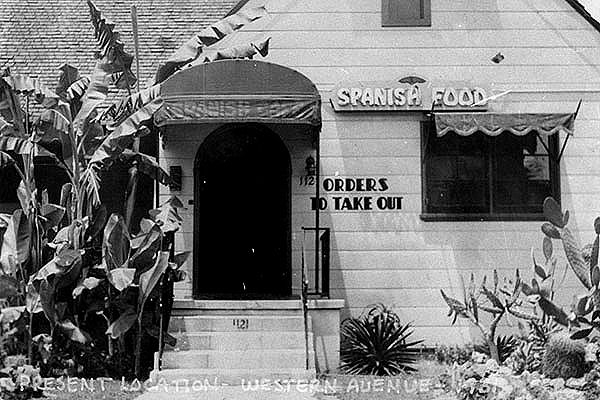
100 years ago, Alexander Alejandro Borquez and his wife Rosa opened a tiny cafe on Moneta Avenue, serving tasty, homestyle Mexican food. Little did they realize that their modest enterprise would survive a century, becoming one of Los Angeles’ most popular restaurants in the process.
As should be expected with Los Angeles’ long Spanish and Mexican history and heritage, these cuisines ranked high with residents, if not officially listed in city records. The 1875 City Directory officially lists a Mexican Restaurant for the first time, and in 1894, City Directory formally lists a Spanish Restaurant downtown. These establishments were unfortunately segregated in an area called Sonoratown, adjacent to both Chinatown and the Plaza, some of the poorest areas of Los Angeles, and the original location of the city. By 1900, city fathers determined to accentuate this Spanish heritage by romanticizing its past. White residents, immigrants, and visitors began searching out food connections to the glorious past. Soon, the Borquez family would open their own restaurant to join the growing boom and popularity of “Spanish” food.
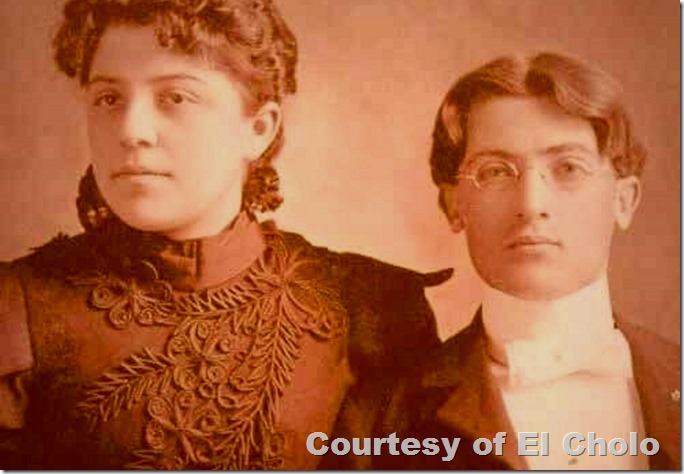
Coming from Arizona looking to get ahead, energetic 19-year-old Alexander Borquez arrived in bustling downtown Los Angeles in the late 1890s. Meeting a 17-year-old Rosa Moreno, also originally from Arizona, he quickly fell in love. Applying for a marriage license January 14, 1898, the two married two days later. Over the next several years, the couple moved back and forth between Los Angeles and his native Globe, Arizona. When they returned in the mid-1910s, Borquez worked as a clerk before conceiving grander ambitions.
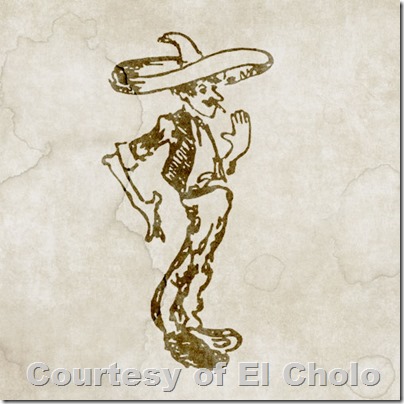
By 1923, the family hungered for more, deciding to open a humble restaurant to serve their needs and others. Borquez joined with partner Rudolph Olea to open Borquez and Olea at 4012 Moneta Ave. and Santa Barbara Ave. Buying out Olea, Borquez continued running the Moneta cafe as well as opening one at 508 W. Washington in 1924 under the name Sonora Cafe. By 1925, the city directory solely lists the Moneta Avenue location. with classified ads that year showing it for sale on account of illness. Various stories over the decades claim that an early patron drew an image of a peasant worker on a napkin which he called “el cholo,” the term early Spanish residents supposedly used to refer to their field hands. The 1928 directory shows Borquez, mistakenly spelled as Vorquez, sharing El Cholo Spanish Food Products Co. with W. V. Martinez and W. F. Wheathoff at 4083 S. Main. Newspaper ads would also list an El Cholo Cafe at 3986 S. Grand in 1930.
Young English born George Spalding fell for the Borquez’ youngest daughter, Aurelia while eating in the family cafe in 1926. Looking for a way to earn money before marrying in 1929, the couple turned to her mother’s tasty recipes. Recognizing their popularity, the two determined to open a tiny cafe saluting the family’s heritage. They purchased a small residence at 1106 S. Western Ave. in 1927, to convert into an intimate cafe featuring three booths and eight stools. Outgrowing the small space, Spalding purchased a 1919 bungalow at 1121 S. Western across the street in 1932. The former home of Hollywood art director and architect Floyd Mueller, sat on a large lot, allowing plenty of room to grow. Green corn tamales, popular on ithe menu at the time, have remained a long time seasonal favorite.
 Loyal employees contributed to the family’s success, many staying for decades. Joe Reina, one of the earliest employees at the tiny cafe, grew up with the restaurant. Joining the team in 1929 to handle odd jobs, by 1932 he rose to cook, eventually becoming head chef in 1935, per a 1977 story in the Los Angeles Times, working for more than 50 years.
Patrons also remained loyal; a young Ray Bradbury lived near the restaurant on 12th street from 1934-1941, but his family was too poor to partake of its tasty treats at the time. Only years later would he actually become a regular presence at the popular hangout.
Popular from the beginning for its sumptous and affordable dishes, the mini cafe quickly expanded to welcome more guests. Multiple renovations would drastically increase its size over the years, seeing it grow ever more elegant and elaborate. Other branches would open across the Southland to help introduce new residents to its popular food. As tastes and styles changed, new dishes occasionally populated the menu; nachos were introduced in 1959, margaritas were first served in 1967, fajitas were introduced in 1984, and table made guacamole made its debut in 2007, though guacamole itself had long been a cafe favorite.
Honoring the restaurant’s centennial this year, Los Angeles named the intersection of Western Avenue and 11th Street as Alejandro and Rosa Borquez Square. El Cholo remains popular today for its friendly vibes, tasty food, and unpretentious atmosphere, a perfect place to relax and enjoy family and friends.

 ladailymirror.com