
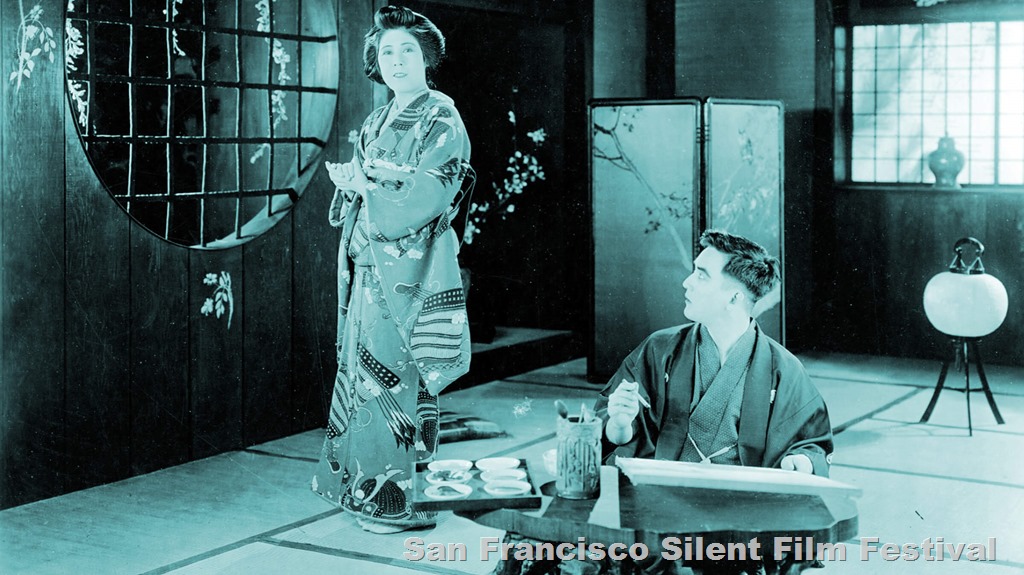
The Dragon Painter, showing at the San Francisco Silent Film Festival.
In 1919, Sessue Hayakawa ranked as one of America’s top matinee idols. Intense, brooding, and handsome, the actor possessed enormous charisma and talent, securing him almost instanteous success upon entering the American film industry in 1914. After several years working under contract for Thomas Ince and Famous Players-Lasky, portraying everything from Native Americans to Indians to Chinese Americans, the actor longed for success producing stories honoring his Japanese culture and shaped around his own persona.
Hayakawa achieved his dream in 1919, establishing the Hayakawa Pictures Corporation in collaboration with Universal director William Worthington. While named after him, the company operated under the leadership of others per incorporation records. Capitalized with money from financiers W. J. Connery and Charles Greenberg, as well as former Christie Comedies general manager F. J. Hawkins and director Worthington, Hayakawa Pictures Corp. produced films starring the actor playing only positive Asian roles at a time when Japonisme widelly influenced popular culture.
San Francisco Silent Film Festival schedule.
Festival passes are $350 for members, $380 for non-members.
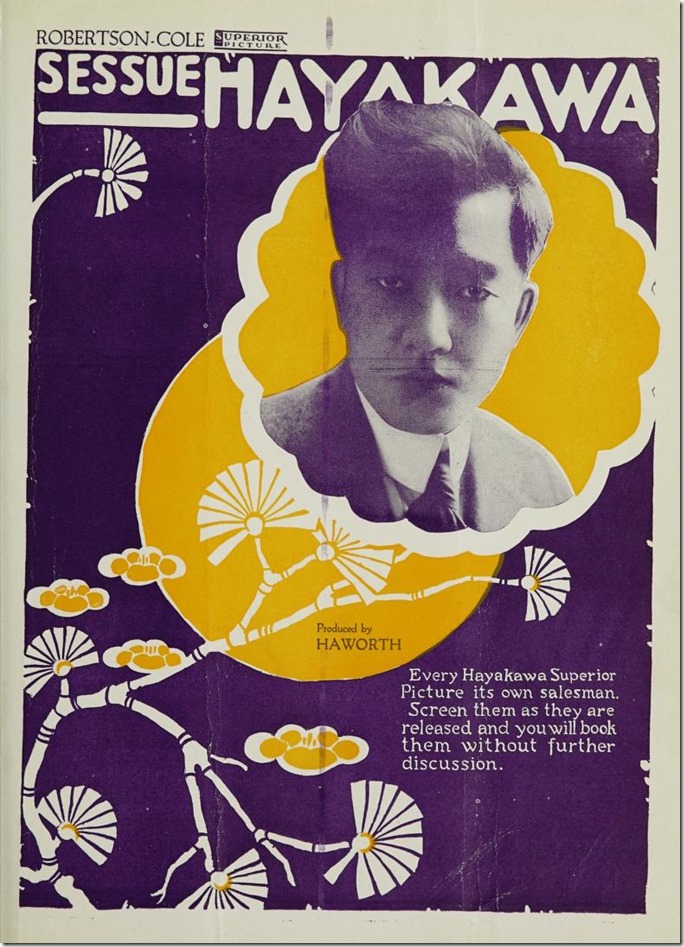
Japonisme, the influence of Japanese art, philosophy, and aesthetics on the West, exploded in the United States after American Commodore Matthew Perry and his armade steamed into Tokyo Bay in 1853. Over the next several decades, Oriental and Japanese culture would romantically influence artistic works like plays and music, interior design in textiles, prints, ceramics, and art, and even landscaping, with West Coast elites creating Japanese gardens designed and maintained by Japanese gardeners. Artists such as Toshio Aoki, adoptive father of Hayakawa’s wife Tsuru Aoki, would design paintings and creative works for upscale audiences often sold at tea gardens. While Japonisme was popular for decades in the United States, resentment was growing against Asian Americans, especially Japanese, throughout the last few years of the 1910s.
It was at this juncture that Hayakawa launched his film production company as a way to highlight his and Aoki’s elegant exoticism and separate them from the petty beliefs expanding around the country. Hayakawa portrayed hard working, courageous, ethical businessmen and artists honoring his Japanese heritage in films often starring his wife Aoki as his love interest, usually directed by the renowned Worthington.
 In the summer of 1919, Hayakawa and company began production on “the dramatic story of a Japanese artist” called “The Dragon Painter,” based on the novel of the same name by author Sidney McCall. Writing under the pseudonym of McCall, Mary McNeil Fenolossa often penned stories saluting the arts and culture of Japan, where she had spent much of her adult life while married to Asian art scholar and collector Ernest Fenollosa. “The Dragon Painter” revealed the story of an aging Japanese artist hoping to pass on artistic traditions to his younger disciple before Western ideas of culture entered the popular mainstream. The film instead focused more on the young artist trying to find his “dragon princess,” and how romance instead might possibly destroy his gift. It featured a four person cast, almost all Japanese.
“The Dragon Painter” features many elements that seem to honor Aoki’s late adoptive father Toshio, a renowned artist himself. Born Hyosai Aoki in Japan, the artist immigrated to San Francisco in the 1880s and began working as an itinerant performer and painter, whose work blended an appreciation of the Japanese supernatural with western progressive influences like shading, intricacy, and and spatiality. First working as a touring performer of Japanese productions for an English company exporting Japanese goods, Aoki spent the majority of his life in California and specifically Pasadena, crafting artistic and ceramicworks sold to upscale society ladies at G. T. (George Turner) Marsh tea gardens like the one in Pasadena on Fair Oaks Avenue and California Boulevard, and later creating set designs, artistic rooms, and serving as art instructor.
He often entertained wealthy and celebrity visitors to the Crown Valley during the winter, with his ward often in attendance at these parties. Chelsea Foxwell describes Aoki as twice marginalized “by the structures of Orientalism and anti-Japanese sentiment in California” and the other by Japanese journalism following the Russo-Japanese War…” in her article for the journal “Nineteenth Century Art Worldwide.” She also states that Aoki’s art may appear in the film, and that his style appears to have influenced some of the paintings by Hayakawa’s character Kato. The senior artist Kano also appears modeled on Aoki, in that he champions older art traditions dying in Japan, as did the late Aoki, a last of his line painter keeping traditions alive and looking for an artistic heir, one who might love and support his daughter.
 In July 1919, Caifornia newspapers revealed that the Worthington-directed production was employing the Marsh Coronado tea garden as a night time location, a popular site for high end guests visiting the San Diego area or the Hotel Del Coronado. Most of the filming occurred at Yosemite Valley, standing in for Japan’s Mount Hakone, an extinct volcano often an object of religious veneration in the country. The movie employed the area as locations for waterfall and lake scenes as well. Motion Picture News claimed that the film shot not only in “God’s garden,” but that the production even duplicated the village of Hakone, Japan, down to its Shinto gates. Worthington supposedly shot from peaks above and patiently waited for the right light and clouds to create the exact atmosphere he desired.
Some trades stated that Aoki assisted with costuming to ensure that her character was outfitted in the correct design and color of her kimonos, which would reveal either her single or married status. She told Picture Play Journal that it sometimes required three maids to help her dress in actual kimonos, which to be accurate, were to be folded to the right.
The fillm opened in late September 1919 to mostly fine reviews. Most of them highly praised the film for both is acting and artistic design. Exhibitors Trade Review called it one of Hayakawa’s best performances, and a production that would demonstrate to audiences that film could actually be a work of art. Motion Picture News stated “the story itself is suggestive of an old legend of the land of its locale, Japan…That a film so realistic of the Orient can be produced in California is almost beyond belief…. ” The Los Angeles Herald called the production “a film poem, an idyll, embodying..some ancient poetic legend of the Japanese.” “The Dragon Painter” existed more as a tone poem and almost myth-like fairy tale revealing how the almost mad painter’s great love for his “dragon princess” inspired his art.
Moving Picture World found the film beautifully shot, acknowledging the fine laboratory work and the splendid developing and toning of the print. They called the production “high class, clean of moral and beautiful in conception.” Frank Williams captured beautiful reflections and compositions with his excellent lighting. Picture Play magazine called “The Dragon Painter” a “picturized ray of sunshine.” They also stated, “There is a gossamer quality about the theme which compensates for its lack of dramatic substance.” Billboard thought that the film would “appeal to lovers of the whimsical and beautiful, for many scenes are enchanting in their reproduction of nature’s wonders.Many ads themselves promoted the majestic Yosemite location, with designs highlighting the breathtaking Yosemite Valley.
The San Francisco Silent Film Festival, under the direction of Board President Robert Byrne, restored “The Dragon Painter” with original tints, new English subtitles, and newly discovered footage by employing the only two surviving original copies of the film from the Eye Filmmuseum in Amsterdam and Rochester’s George Eastman Museum, both containing material not present in the other. Much new footage enhancew Aoki’s performance, giving further texture to her role.
“The Dragon Painter” plays Friday, July 14 at 7 pm at the Castro Theatre, offering a visual feast for audiences.

 ladailymirror.com