
Nothing, but Nothing Is Sacred Any More
 It’s every reporter’s dream to lay aside his battered old felt hat, shred his press card into confetti, turn his World War II surplus trench coat over to the Salvation Army, take his smudgy copy pencils one by one and snap them into little pieces, and — casting a defiant look at his city editor as he leaves — go home, strip down to his waist, put on his imported silk smoking jacket, retreat up to the attic with his favorite pipe, wipe the dust off his lonely, long-idle portable, sit down, squeeze into his slippers, and knock out the great American novel.
(And if his novel includes one sentence like the above, he might just as well forget the whole thing.)
Anyway, that’s every reporter’s dream — but mine.
|
I could do it. I’m perfectly capable. I got plots and subplots and protagonists and themes bottled up inside me till they’re coming out of my ears. But I won’t do it. And I have good reason. It used to be, before this age of scandal-mongering and expose, that a fellow could bat out a literary classic with reasonable assurance that when he died, he’d be remembered by future generations with some reverence. It used to be, I say. But nothing is sacred any more.
Who knows how many hours he sweated over a line like this, “Alas, poor Yorick! I knew him well.” I don’t know what it means, but it’s obviously solid prose. Yet, since he’s passed on, they’ve advanced the rumble that a ham named Bacon really wrote his material. Oscar Wilde is another example. He was a literary genius, but you know what they did to his reputation. They didn’t come right out and say it. But those little insinuations. Those damnable little insinuations. Then there’s the great Irish playwright, Brendan Behan. He isn’t even dead yet and they’re already calling him a drunk. That people blasphemed this trio of tremendous talents never really bothered me much. In fact, I’ve been on the verge of believing the whisper campaigns against them. But last week, the character assassins went one step beyond credulity.
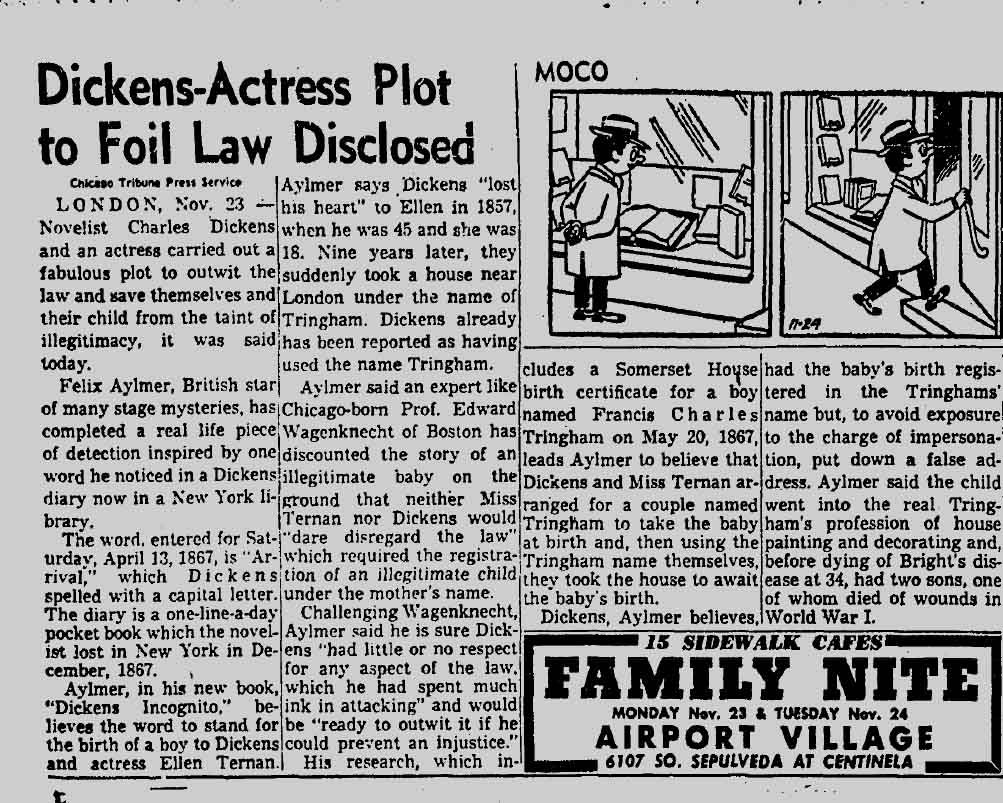
According to an Associated Press dispatch of last Friday, Aylmer claims that Dickens and Ellen conducted their illicit trysts by sneaking off to Slough, which no decent couple would do. I mean, after all — “Sneaking off to Slough!” It’s like sneaking off to Miami when the summer rates are in effect. And I’m personally offended at the charge. It happens that my family, for generations, has been raised on Dickens’ “A Christmas Carol.” My grandmother read it to my mother. My mother read it to me. And I, every holiday season, take it off the shelf to instill the true spirit of Christmas in my own children. (To those of you who are a bit fuzzy on the book, its hero, Scrooge, a jolly merchant, teaches the rest of the shiftless townfolk the importance of thrift.) Now Here’s a Custom It’s been my custom, each Christmas Eve, to sit in front of the hearth, with my children gathered around me, roasting betel nuts and reading Dickens. I’ve raised them to believe that Dickens was the champion of the Victorian underdog. Now, I don’t know. If they read Aylmer’s book, they’re likely to grow up with the gnawing doubt that is suddenly developing within me that Oliver Twist might not have been a pitiful, hungry, mistreated little tyke. He might have been a goldbrick who was just looking for sympathy and wasn’t pitching in to do his share with the rest of the kids at the orphanage.
|
 A London actor named Felix Aylmer published a book called “Dickens Incognito,” in which he charged that Sir Charles attacked the morals of the Victorian age merely to cover up an affair he was having with a starlet named Ellen Ternan.
 ladailymirror.com