
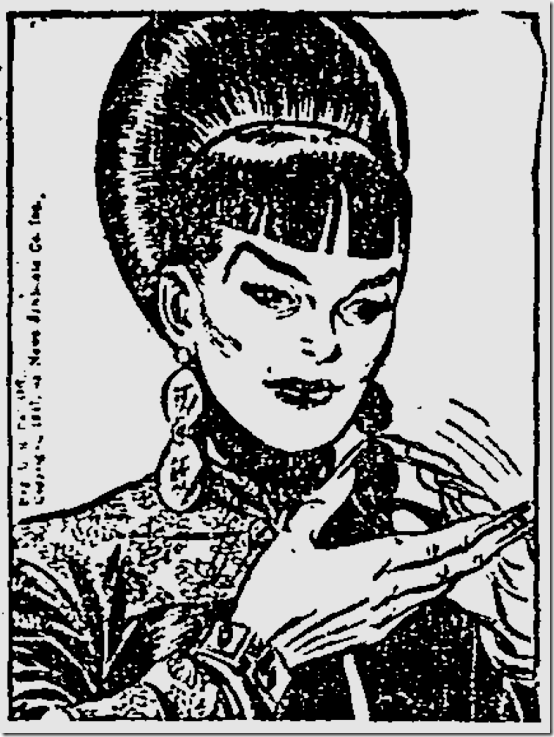
For Monday, we have a mysterious woman. Continue reading
For Monday, we have a mysterious woman. Continue reading
Welcome to the first session of the Black Dahlia Book Club! I finally got tired of talking about George Hodel and Steve Hodel (at this point, I know Steve’s monologues from memory) so I decided to spend some time looking at the portrayals of the Black Dahlia case, starting with the October 1948 issue of True Detective, which touched off the Leslie Dillion debacle. I consider myself first and foremost a historian of the Black Dahlia case, and think it’s important to examine the source material in detail to emphasize the challenges of researching the murder of Elizabeth Short.
The next Ask Me Anything on the Black Dahlia case is February 3. The next Black Dahlia Book Club session will be February 17. I’ll announce the subject a week before.
In this session, I discussed: Continue reading
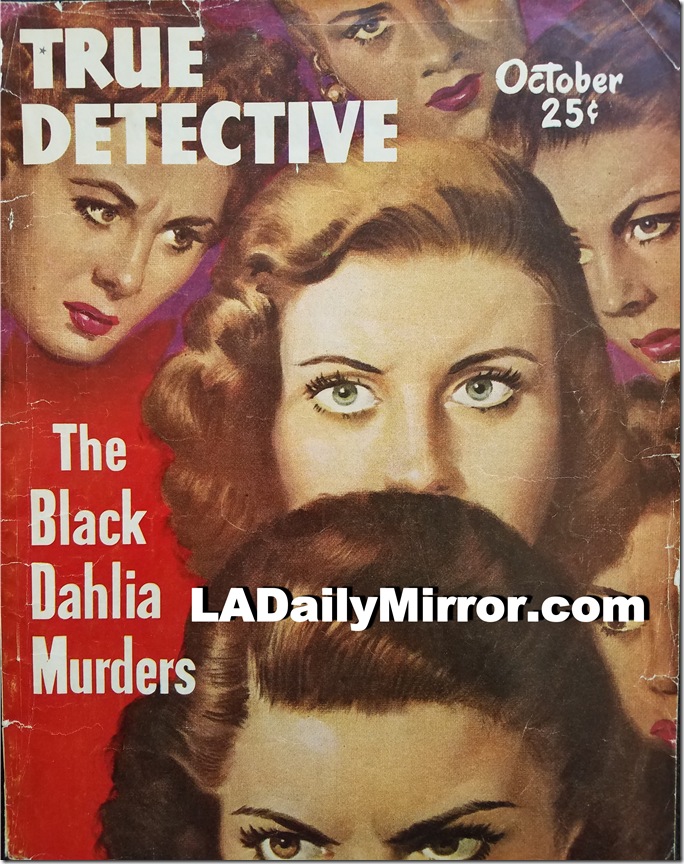
Note: Two pages were inadvertently omitted from the upload. They have been added. Thanks to everyone who pointed this out.
Introducing the Black Dahlia Book Club, beginning January 20, 2026, in lieu of the Ask Me Anything sessions on George Hodel and Steve Hodel.
I’m going to begin with “The Black Dahlia Murders,” by George Clark, from the October 1948 issue of True Detective. This isn’t the first pulp magazine article about the murder of Elizabeth Short, but it is by far the most influential because it resulted in the Leslie Dillon debacle.
Note: The article was written from newspaper articles and must be approached with skepticism.
I’ll discuss the article in my live YouTube session, January 20, at 10 a.m. Pacific time on YouTube/LMHarnisch. Email me your questions and I’ll answer them!
The article is on the jump. Continue reading

Black Dahlia: Murder, Monsters, and Madness in Midcentury Hollywood, by William J. Mann, Simon & Schuster, 464 pages, January 27, 2026, $31.
Like a game of Clue with an actual cold case to solve, a well-worn list of suspects in the 1947 Black Dahlia killing released 22 years ago continues to provide the “true” crime community and the multimillion-dollar industry that feeds it with endless possibilities for speculation and, occasionally, another book.
Was it the murderous Dr. George Hodel at the Sowden House in a gruesome attempt at surrealist art? Mob nightclub owner Mark Hansen at the Florentine Gardens hiring morgue-trained assassin Leslie Dillon to take care of a troublesome dame? Army butcher Carl Balsiger in a fit of violence?
All of them are fakery and fraud by writers Steve Hodel (the ongoing Black Dahlia Avenger franchise launched in 2003), Piu Eatwell (Black Dahlia, Red Rose, 2017) and Eli Frankel (Sisters in Death, forthcoming in October 2025) who, if they read all of their source material, knew their suspect wasn’t the killer and proceeded anyway. Truth is the first victim for a “true” crime author with hopes of making The New York Times bestseller list and everything that goes with it. Continue reading

Note: This is an encore post from 2007.
Jan. 27, 1907
Los Angeles
One thing you can say about Angelenos: We love to talk about traffic. The only thing we love more is to commission studies and draft plans to deal with the problem, and then ignore them.
“With the wonderful growth of Los Angeles as a great city has come to it many problems to be solved. The Owens River and the system of storm drains underway are the solutions of two important ones,” The Times says.
“Don’t Be a Sucker” is on YouTube.
Note: This is an encore post from 2017.
Still as relevant today as when it was first produced over 70 years ago, the United States Army Signal Corps’ short “Don’t Be a Sucker” describes the founding principles of the United States’ Declaration of Independence and Constitution, that all people are created equal and should share in the bounties and freedom that they and all parts of our melting pot have created. From its beginnings, our country has welcomed people from around the world, blending voices and lives to create a wonderful smorgasbord of culture. Without all those beautiful grace notes, America would not be the country it is.
The Signal Corps created all types of films for the Army during World War II: training and instructional films, propaganda, rallying, and patriotic pieces, all aimed to get soldiers to devote their all in fighting our enemies to preserve our way of life. Most were never intended to be viewed by the general public, aimed strictly at the boys going overseas, both during the fight and then to prepare them for returning home and demonstrating these honorable values to others.
Hollywood at Play, by Donovan Brandt, Mary Mallory and Stephen X. Sylvester is now on sale.
Note: This is a post I wrote in 2006 for the 1947project.
Savant seeks key to
mental telepathy in
radar, light waves
PORTLAND, Ore, Jan. 24—(U.P.) An electrical engineer said today he thought the answer to mental telepathy might be found in the unexplored frequency band between ultra-short radar waves and the longest waves of light.
Dr. Phillips Thomas, for 35 years a research engineer with the Westinghouse Electric & Mfg. Co., said he was so thoroughly convinced that the answers would be found that he plans to devote his own time to the research.
January 24, 1944
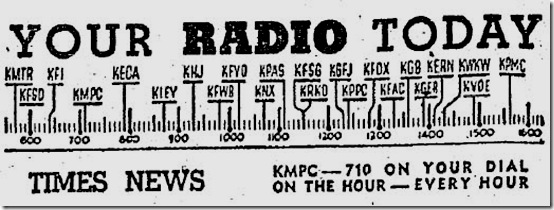
It’s Monday in 1944 and today we have:
—“Information Please,” hosted by Clifton Fadiman, with John Kieran, Franklin P. Adams, Elizabeth Janeway — author of the bestseller “The Walsh Girls” — and music critic Deems Taylor. I invite the Brain Trust to try these questions. They can be tough! Courtesy of Archive.org
—“Casablanca,” starring Alan Ladd as Rick and Hedy Lamarr, on “Lux Radio Theatre.” Courtesy of Archive.org.
—“Stolen Patrol Car” on “Hop Harrigan.” Courtesy of Archive.org.

Note: This is an encore post from 2007.
January 24, 1907
Los Angeles
Meet a tough little lady who gave her life to helping the poor, needy children of Los Angeles. She built a church and school starting with a nickel donated by a newsboy, left it all and began again in a tent when the presiding minister turned out to be a crook, and then regained it all. She spent most of her later years fighting with state authorities to stay in operation. Her name is Belle L. White.
White was preaching as early as 1897 at the Pacific Gospel Union, working with needy children in the neighborhood east of Alameda Street. But in a few years, when the Gospel Union decided to give up working with youngsters, White split off and formed her own school at 6th Street and Mateo.
January 23, 1958
 Confidential magazine may have purged itself of obscenity but the expose complex it created is not so easily dispelled.
So says an experienced writer of fact articles.
The way he analyzes the present situation, the public’s appetite for gossip and scandal, whetted by Confidential, is now being satisfied by the so-called conservative magazines.
Their editors who a year ago wouldn’t have dreamed of going for the racy stuff are now rejecting assigned articles on celebrities when the subject refuses to tell all. These editors insist their writers get full confessions, regardless of whose privacy is invaded, or no sale. Continue reading
Jan. 23, 1958
 There’s an old saying that I frequently call upon which goes:
“Omnia vincit amor.”
It means “Love conquers all”–and I think it’s pretty applicable to what’s going to happen to the U.S. Marines.
I think so because, shortly after dusk last night, I was invaded by some dozen wives of the corps. And I can truthfully say that I think the shores of Tripoli fared better than I did.
The women were, in mild English, disgruntled. In stronger English, angered. Or in corps English, fighting mad.
–Not, fortunately, at me. Continue reading
Note: This is a post I wrote in 2006 for the 1947project.
Murder
Four held for Trial in
‘Hibiscus’ Slaying
After a weeklong preliminary hearing, four of five youths arrested in the Lincoln Park “hibiscus” murder case were today held to answer to Superior Court by Municipal Judge Arthur Guerin.
Freed after the hearing was Ephrem “Baby Face” Olivas, 18, who was named by the four others as the slayer of Naomi Tullis Cook, 52, whose beaten body was found under a clump of hibiscus bushes in the park near the men’s restroom.
 Note: This is an encore post from 2007.
January 23, 1907
Los Angeles
Pity, for a moment, Felix Chavarino, caught in the grips, not of opium, morphine or heroin, but of citrus, for he is a “lemon fiend.”
He was arrested after begging for food in a small restaurant. Chavarino didn’t want anything else on the menu, pleading for a “le-mon,” a “le-mon.”
“Gaunt, unkempt and weird looking, he crouched there, disdaining all offers,” The Times says.
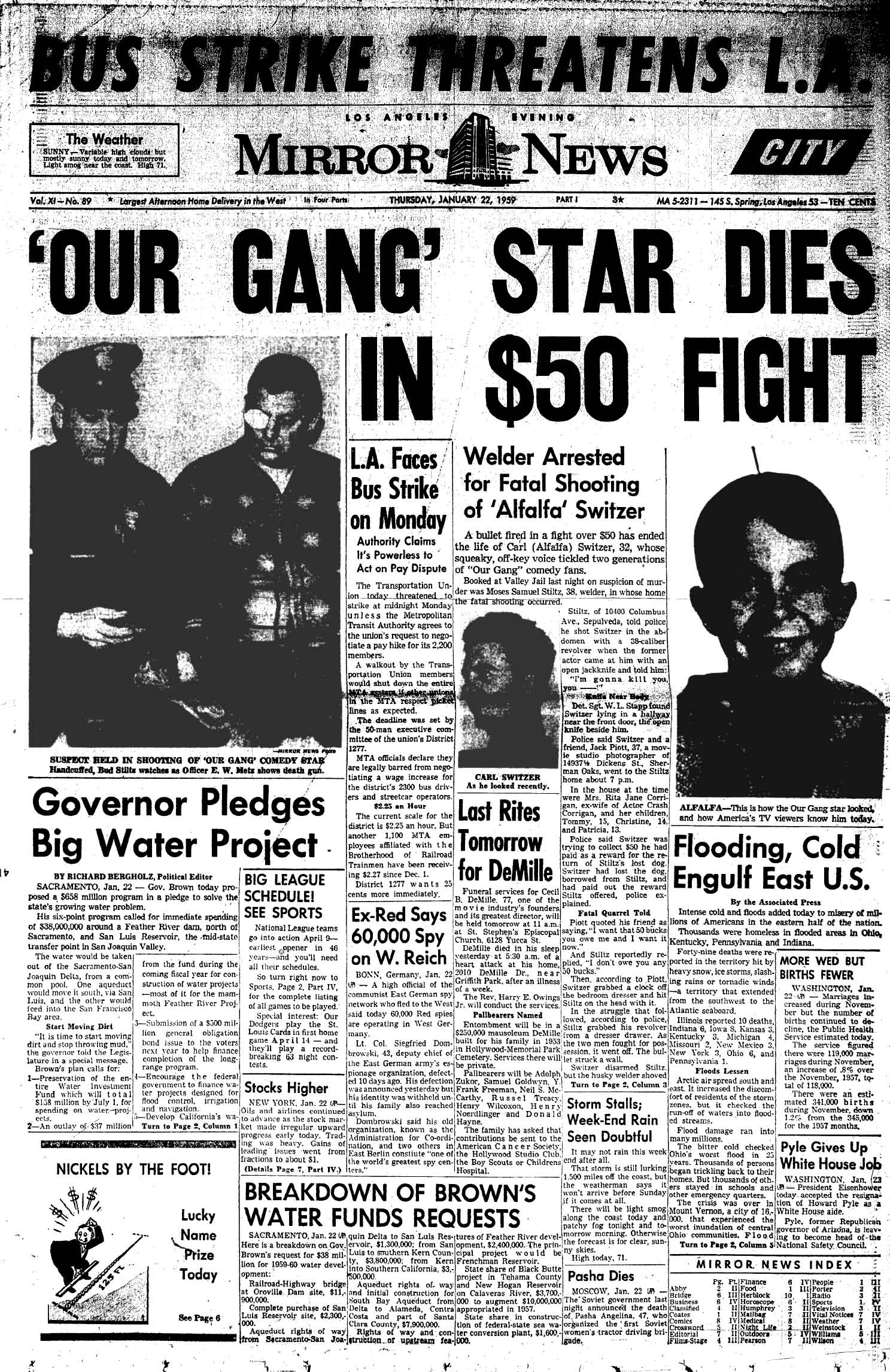
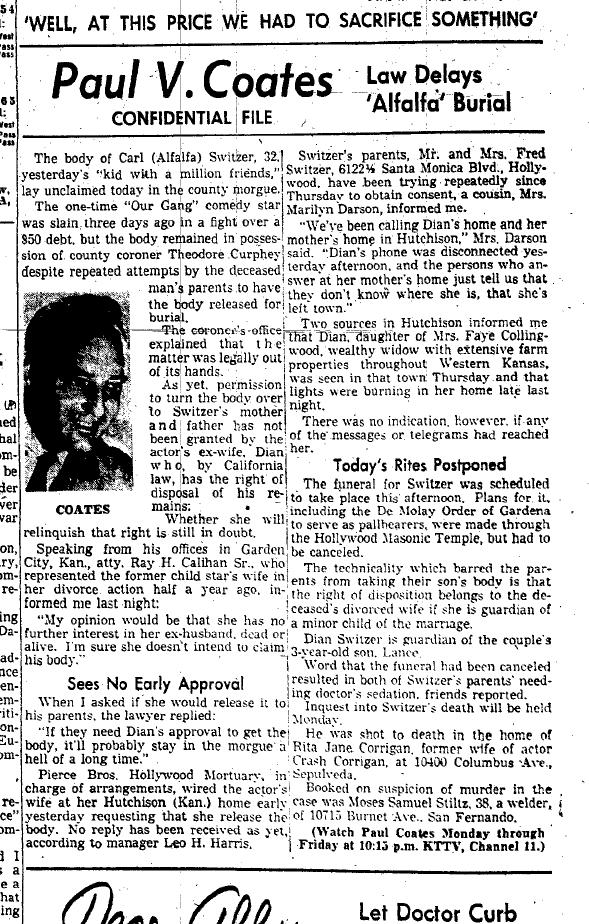
Jan. 22, 1959: Carl ‘Alfalfa’ Switzer is shot to death in a fight with Moses Samuel Stiltz. According to police, Switzer borrowed a dog belonging to Stiltz, then lost the dog. Switzer paid $50 for the return of Stiltz’s dog. Switzer decided Stiltz owed him the money and a fight ensued. Somewhere there should be the line: “both had been drinking heavily” and here we have it: “Switzer had three beers and a Martini.” The shooting occurred at the home of Rita Jane Corrigan, former wife of Ray “Crash” Corrigan. Continue reading
Note: This is a post I wrote in 2006 for the 1947project.
‘Large Nose’
Seek Bandit in $28,000
L.A. Bank Holdup
“Large Nose,” a bandit who claims “heroes die young,” was sought by police today for the $28,000 robbery of the Bronson-Olympic branch of the Security-First National Bank.
Armed, the robber forced 19-year-old Dolores Huss, safety deposit box attendant, to open the vault and allow him to scoop up handfuls of money held as surplus cash.
The bandit handed the girl a list of instructions:

Note: This is an encore post from 2007.
January 22, 1907
Los Angeles
Since his teens, James Lauer has been studying the Bible. Where others have struggled to parse its meanings, he has found clarity. He wants to write a book that will explain it all. The only thing he needs is $1,000 ($20,523.57 USD 2005).
During his studies of the Bible, Lauer has apparently never encountered anything prohibiting extortion, so to get the money, he has been writing notes to Mrs. Joseph Maier Sr. One was not enough, so Lauer wrote a series of letters demanding money and threatening her life if she didn’t pay.
Now that Anastas Mikoyan has returned whence he came, a lady named Natasha Smith would like a few unkind words.
She was born and reared in Russia and barely escaped with her life during the revolution. She speaks and understands the language.
She watched TV interviews in which Mikoyan answered questions through an interpreter. She knew what he and the interpreter said. She found Mikoyan very sharp and admired his sense of humor.
She is certain, however, that Mikoyan understands some English and used the time taken to translate to figure out his answers, usually evasive or retaliatory. Continue reading
In the smut business, the biggest losers are the customers.
They shell out something (more than 1 million dollars a year) for nothing.
But they’re not the only ones who come out on the short end.
A couple of years ago, I printed a letter received by an 11-year-old boy here in town.
It was the typical pitch to peddle nude photos, written as a “personal” note.
It said, in part:
“Maybe it isn’t proper for a girl to write to a strange man this way, but I hope you don’t mind . . . Continue reading
Note: This is a post I did in 2006 for the 1947project.
Marley Griggs and his sidekick Oliver Gebhart had the perfect alibi for the burglary of a market on Western Avenue—they were already in custody 60 miles away.
The men were model prisoners at the Los Angeles County Sheriff’s Department’s Road Camp No. 5, where Griggs was serving time for forgery and Gebhart was sentenced for burglary of a safe.

January 21, 1907
Los Angeles
Mayor Arthur C. Harper addressed the crowd for a moment, reminiscing about a teacher who used to tell his pupils that someday, long after he was gone, people would get around Los Angeles in self-propelled vehicles.
And with that, Harper threw the switch, illuminating 10,000 electric lights at Morley’s Skating Ring on Grand between 9th and 10th Streets and beginning the insanity, formally unveiling the automobile in the first car show not only in Los Angeles, but on the West Coast.
Note: This is an encore post from 2005 and originally appeared on the 1947project.
I was talking with Siegel about seven o’clock on the Friday evening of his death. He called me at the office of Hollywood’s Daily Variety, for which I was then writing a column. He said he wanted to thank me for a review I had given the floor show at the Flamingo that week.
“I’m planning a whole new advertising campaign and am using your description, ‘the fabulous Flamingo,’ prominently in all the ads,” he told me. “I’m cutting prices in the rooms, too, and have just signed the Ritz brothers to open in September. I’m paying them $25,000 a week ($236,604.65 USD 2005), but I think they’re worth it.”
Note: This is a post I wrote in 2006 for the 1947project.
With the city in the grips of the Black Dahlia murder, Los Angeles wonders, where is Virginia Mayo? Or at least some publicist worries enough to feed the item to Louella Parsons at the Examiner. Without knowing for certain, the second story looks like a Times rewrite of the gossip column, which provides juicy details about Mayo’s poisoned dog, her exact address and the implications that she’s a home-wrecker, but is very thin on any real news. Basically, Mayo and her mother went on a trip. End of story.
Bonus factoid: Mayo and O’Shea got married July 2, 1947. He lived at 14633 Magnolia in Van Nuys. O’Shea, who starred in “Mr. District Attorney” and “Underworld Story,” died of a heart attack in Dallas in 1973 while getting ready to join a touring company of “40 Carats,” starring Mayo.
Second bonus factoid: Mayo’s apartment was 1.3 miles from the home of Dr. George Hodel at 5121 Franklin Ave.
 ladailymirror.com